
✅ Updated on 05.11.2025

Thailand Plug Type
Different countries use different plug shapes, voltages, and frequencies — that’s why power sockets are categorized into types like A, B, C, D, E, F, and so on. For example:
- Most European countries use Type C and F plugs
- The US and Canada use Type A and B
- The UK uses Type G, and sometimes D and M
- In Thailand, things are a bit more flexible. Thai power sockets accept six different plug types: A, B, C, E, F, and O.
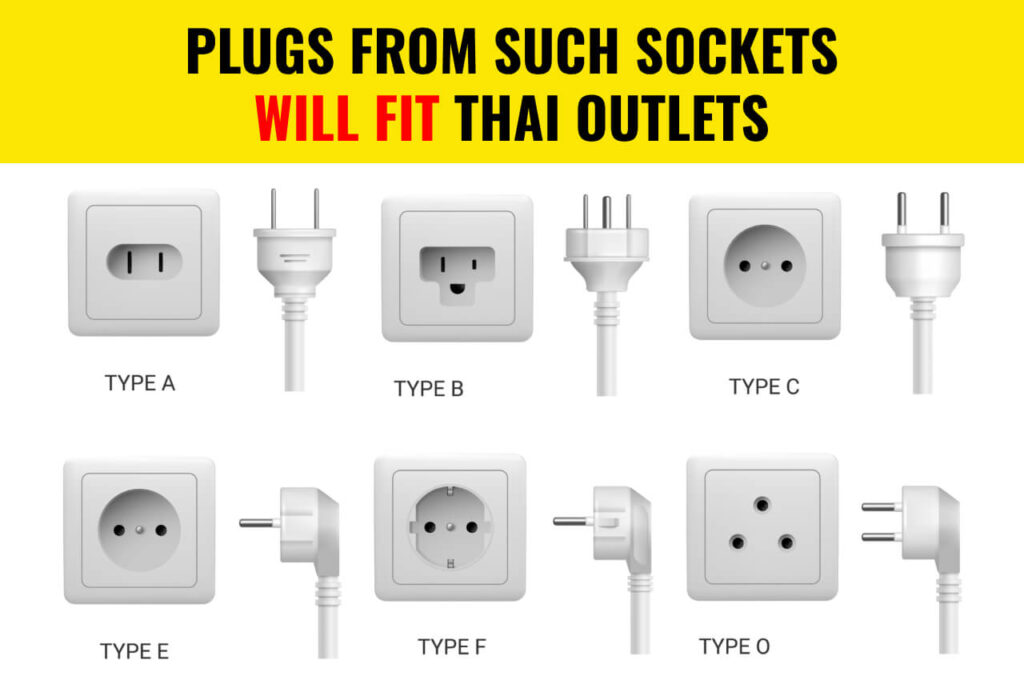
That means if your device uses one of these plug types, it will physically fit into a Thai wall socket. If your country isn’t listed here, you can check the plug type and voltage used in your region on Wikipedia.
However, don’t plug in your device just yet — voltage in Thailand may differ from what your device is designed for. You need to check that before charging or using any electronics.
Compatibility of Devices from Other Countries with Thai Power Sockets

Thailand uses a mix of plug types and runs on 220V at 50Hz. Here’s how devices from different countries match up with Thai power sockets:
| Country | Plug Type | Voltage | Frequency | Compatible with Thai socket? |
|---|---|---|---|---|
| Australia | I | 230 V | 50 Hz | ⚠️ Sometimes — only in multi-type sockets; best to bring an adapter |
| Canada, USA | A, B | 120 V | 60 Hz | ❌ Needs adapter and voltage converter (unless dual-voltage device) |
| China | A, I | 220 V | 50 Hz | ✅ Yes |
| Europe | C, F | 230 V | 50 Hz | ✅ Yes |
| India | C, D, M | 230 V | 50 Hz | ✅ Yes |
| Russia | C, F | 230 V | 50 Hz | ✅ Yes |
| Thailand | A, B, C, E, F, O | 220 V | 50 Hz | N/A |
| UK | G, D, M | 230 V | 50 Hz | ❌ Need adapter |
Electric Voltage in Thailand: What You Need to Know
230V Devices on Thailand’s 220V System
Thailand’s electrical system runs at 220 volts and 50 Hz. Most electronics designed for 230V — including those from Europe, Russia, India, and the UK — will work perfectly fine in Thailand.
The voltage difference is minimal (within the ±10% tolerance allowed by most manufacturers), so common devices like laptops, phone chargers, and hair dryers usually work without any issues.
✅ No voltage converter needed — just bring a Thailand plug adapter if your plug shape doesn’t match.
American and Canadian Devices (120V / 60Hz)
Travelers from the US and Canada should take extra care. North American electronics are designed for 120V at 60Hz, while Thailand uses 220V at 50Hz.
- Dual-voltage devices (like most modern phone and laptop chargers, cameras, and shavers) are marked with: “Input: 100–240V, 50/60Hz”. These work perfectly in Thailand
- Single-voltage devices (like many hair dryers or older electronics) can be damaged or destroyed if plugged into Thai power sockets without a voltage converter.
👉 A voltage converter or transformer is required for those — but they’re often bulky and impractical. It’s usually easier to leave such devices at home and use hotel amenities instead.
Why Do Thai Power Sockets Have Three Holes?

If you look closely at a Thailand power socket, you’ll notice three holes — the third, smaller one is for grounding.
Grounding helps protect you from electric shock in case the wire is damaged, and it also helps discharge any built-up static electricity. It’s a useful safety feature — but not always essential.
If you’re plugging in devices with Type A, C, E, or O plugs directly into a Thai wall plug, grounding is usually not connected. That’s generally safe as long as your device’s cable is intact. I personally do this all the time when charging my phone.
But if you prefer extra safety, you can buy a Thailand power adapter or a grounded multi-plug that connects to the ground pin.
Electrical Adapter for Thailand: Where to Buy and What It Costs


If you need a Thailand plug adapter or a multi-plug, the easiest place to buy one is Mr. DIY — a popular hardware and home goods store found in nearly every city in Thailand. You’ll even find them on islands like Koh Samui.
Here’s what you can expect in terms of pricing at Mr. DIY:
- Basic plug adapter: 45 baht ($1.4)
- Grounded multi-plug with USB ports: 330 baht ($10)
These are inexpensive and widely available, so there’s no need to bring one from home unless you already have it.
