
✅ Updated on 08.09.2026

What Is a Residence Certificate in Thailand?

A residence certificate is an official document that confirms your current address in Thailand — in simple terms, it’s a form of temporary registration.
❗️ Important: The TM30 form and the certificate of residence are two different things.
The TM30 is filed by your landlord or hotel, while the residence certificate is issued by the Thai immigration office.
To put it simply:
- When your landlord submits a TM30, they’re notifying the government: “This foreigner is staying at this address.”
- When the immigration office issues a certificate of residence, they’re officially confirming: “Yes, this foreigner does indeed live at this address.”
Why Do You Need a Residence Certificate in Thailand?

The certificate of residence is essential for foreigners when dealing with Thai government agencies. The most common situations where you’ll need it include:
- Applying for a Thai driver’s license
- Opening a bank account in Thailand
- Registering or purchasing a vehicle
I Got My Residence Certificate on a Visa-Exempt Stamp
Yes, you read that right — you don’t need a student visa or any other long-term visa to get a residence certificate in Thailand.
How Long Does It Take to Get a Residence Certificate in Thailand?
Processing times for the residence certificate vary depending on the region where you apply. I applied in person at the Bangkok immigration office, and my certificate was ready 7 days after submission.
Here’s what my subscribers have shared about their experience in different provinces:
- Phuket, Rayong, Hua Hin, Krabi — Between 30 minutes to 2 hours, depending on how busy the office is
- Pattaya, Chiang Mai — Ready the next day or sometimes same day
- Bangkok and Koh Samui — 7 days
Validity Period of a Residence Certificate

The residence certificate in Thailand is valid for 30 days — this is clearly stated in the bottom left corner of the document.
Cost of a Residence Certificate
The cost of getting a residence certificate in Thailand varies by province:
- Bangkok — Free
- Pattaya — ฿300
- Hua Hin, Phuket, Rayong, Chiang Mai, Krabi — ฿500
One subscriber mentioned that in Chiang Mai, it’s possible to get the certificate for just ฿60, but the processing time is much longer — around three weeks.
Where to Get a Residence Certificate in Thailand
The Certificate of Residence must be obtained at the immigration office of the province where you live. This is because it is issued based on the TM30 notification, which is completed by your hotel or by the owner of your partment.
Immigration Office Locations:
- Bangkok
- Phuket (Patong, Phuket Town)
- Pattaya
- Koh Samui
- Koh Phangan
- Chiang Mai
- Krabi
If you are obtaining a Certificate of Residence in Bangkok, go up the escalator to the 3rd floor. You will see a sign that says “Residence Notification (Counter B)” — that’s where you need to go.

Documents Required to Get a Residence Certificate in Thailand
To apply for a Certificate of Residence, you will need the following documents:
- Copy of TM30 — keep the original with you, as it may be needed in the future. (Read the article about TM30 to avoid common mistakes.)
- Copy of your passport — the main (photo) page and the page with your latest entry stamp to Thailand (if you have a student visa, make a copy of the visa page instead of the entry stamp page).
- Original passport
- One 3×4 photo — not required in Bangkok, but needed in other provinces.
- Copy of the 90-day report — if you have been living in Thailand on a long-term visa for more than 90 days. (read more here)
You can usually take the photo right at the immigration office — it costs about ฿100. Document printing is also available on-site, typically ฿3 per page.
❗️Important: If you’ve left Thailand and re-entered, make sure to update your TM30. An outdated TM30 is considered invalid, and you’ll be denied the certificate. Personally, I just message my agent — she updates the check-in date and sends me a fresh TM30.
How to Get a Residence Certificate in Thailand: Step-by-Step Guide
Time needed: 7 days
✅ This guide is based on my personal experience in Bangkok, but it’s also applicable in other provinces across Thailand. Even if the process differs slightly, knowing the main steps will help you easily adapt on the spot.
- Prepare Your Documents
Make a copy of the first page of your passport, the page with your latest Thai entry stamp, and your TM30 form. Bring your original passport with you. If you’re applying outside Bangkok, you’ll also need a 3×4 cm color photo.
- Go to the Immigration Office
Arrive as early as possible to avoid delays, especially due to the lunch break from 12:00 to 13:00. I arrived at 10:00 AM, but just before my turn, the break started. I ended up spending about five hours at the office.
- Fill Out the Application Form
Complete the residence certificate application form. It’s fairly intuitive, but feel free to use a translator app if needed. I recommend bringing your own pen to save time.
- Get a Queue Ticket
At the information desk, hand your documents to the staff. They’ll staple everything together and give you a ticket with your queue number and the section where you’ll be called.
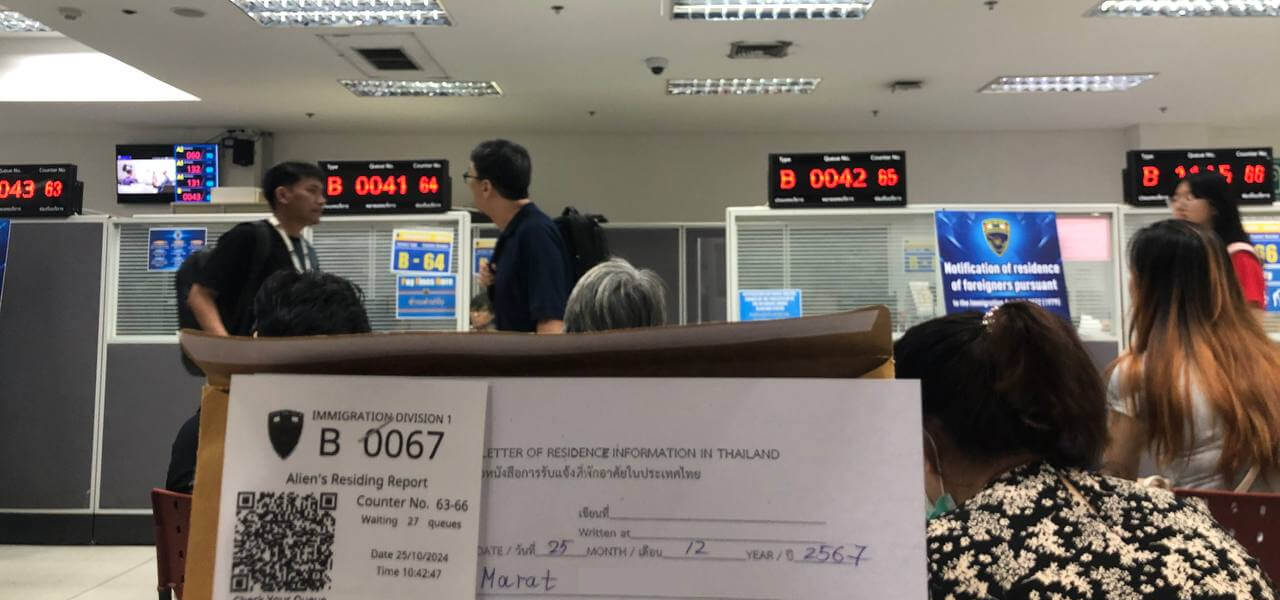
- Submit your documents
When your turn comes, submit all the documents. The officer will give you a slip of paper with the date when you need to come back to collect the certificate.
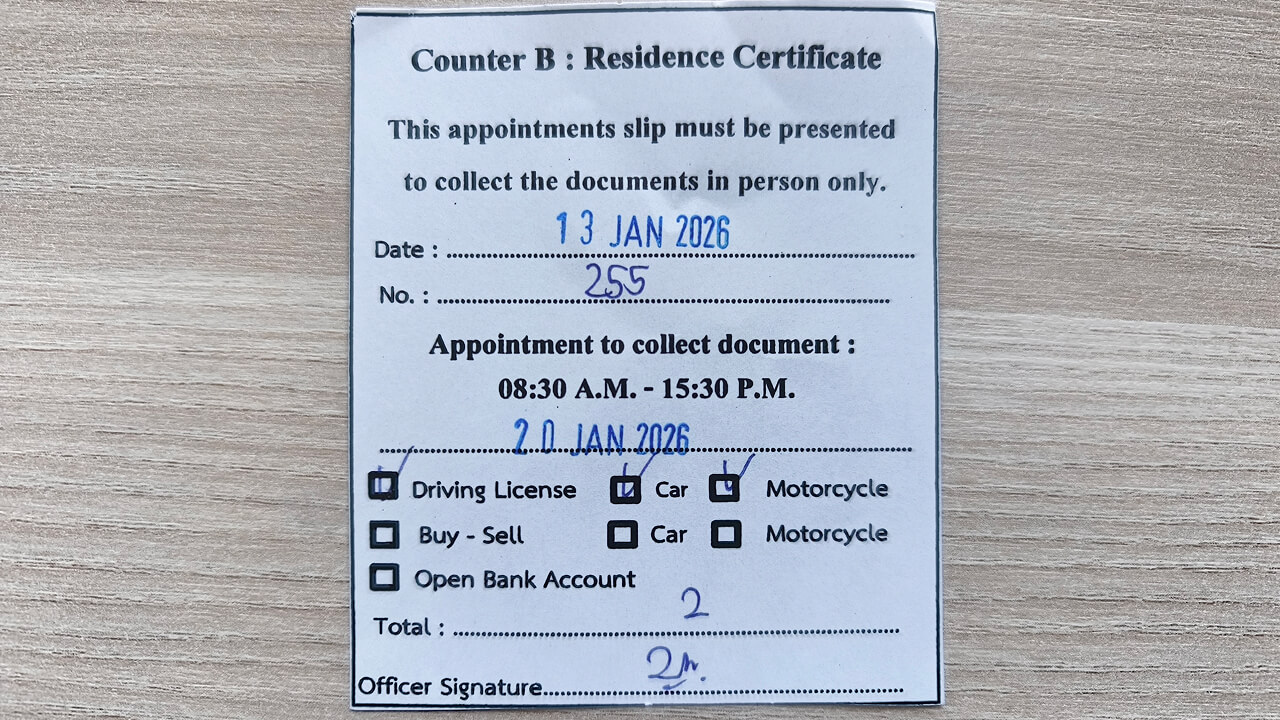
- Collect the Certificate of Residence
On the scheduled date, return to the immigration office. Go to the same counter where you received your queue ticket previously, and you will be given your Certificate of Residence.


In Pattaya and Chiang Mai, you can usually return to collect the Certificate of Residence on the next working day. In Hua Hin, Rayong, and Phuket, the certificate is often issued within 30 minutes to a couple of hours, depending on how busy the office is.
In Bangkok, it used to be possible to pay 200 baht and have the certificate sent by mail. This option is no longer available. Now you need to visit the immigration office twice: once to submit the documents and a second time to collect the certificate.
Mistakes I Made While Getting My Residence Certificate
- ❌ I specified only one purpose for the certificate
In some immigration offices, like in Bangkok, the residence certificate is issued for a specific purpose — for example, to get a motorbike license. If you also need a license for a car, you’ll need a separate certificate. I wasn’t aware of this, so the Department of Land Transport rejected my car license application. I had to apply for a second certificate. In other provinces, the certificate may be universal and reusable, so it’s worth checking with your local office in advance. - ❌ I arrived too late at the immigration office
Next time, I’ll go earlier (around 9 AM). That way, I can submit my documents before the lunch break and avoid long delays. - ❌ I didn’t bring a pen
I ended up borrowing one, but it’s always better to have your own so you’re not relying on anyone else.
Conclusion
💪 Good luck with getting your residence certificate! It’s a must-have document if you plan to get a Thai driver’s license.
Once you’ve gone through the process, feel free to share your experience in the comments — it’ll help other travelers and expats.
You can mention:
- Where did you apply for the certificate?
- How much did it cost and how fast was it issued?
- Were you asked to provide a photo?
- Was the Certificate of Residence issued as a single certificate for all license categories, or as separate certificates for each category?
